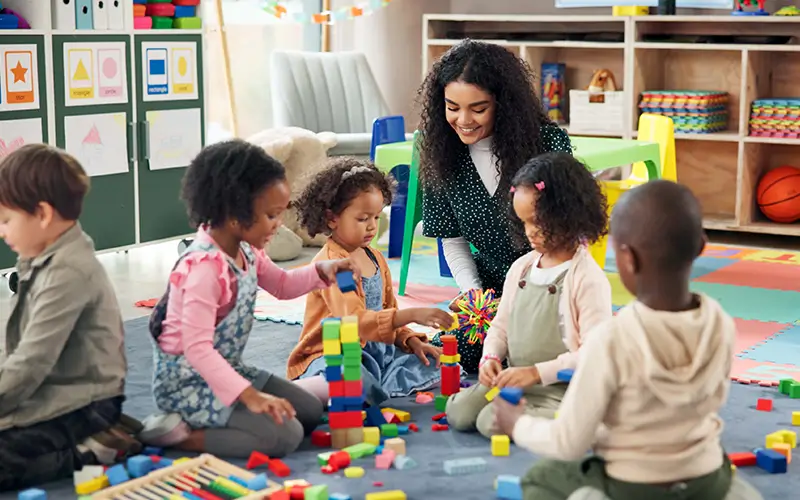
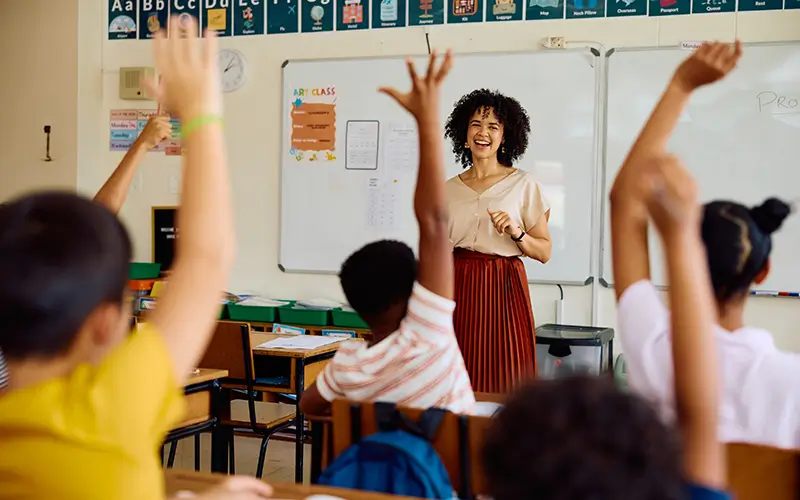
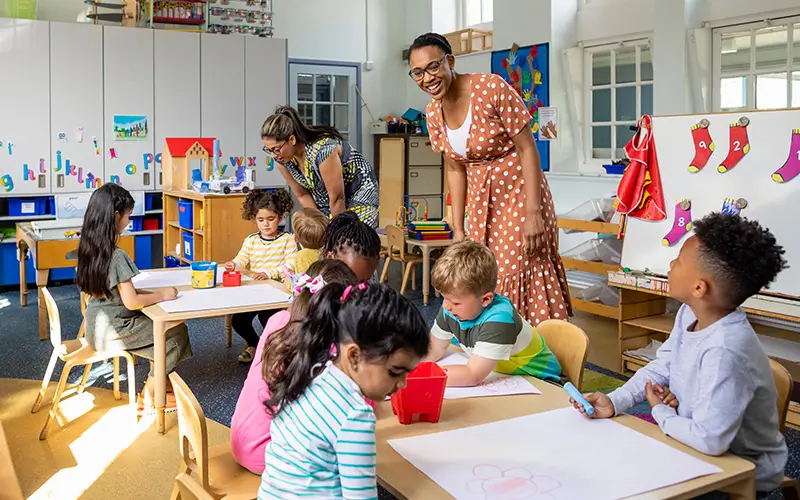
The elementary classroom is a happy community. Students are focused. They take joy in their work. They invent, explore, experiment, confer, create, prepare snacks, and curl up with books; sometimes they might even reflect in a peaceful, meditative corner. Meanwhile, teachers circulate throughout the room, observing the students and making notes about their progress, ever ready to offer support or introduce new material, as appropriate.
Expectations are both exquisitely clear and engagingly open-ended.
The elementary community cultivates your child’s reasoning skills, intellect, and social development by providing individualized and small group lessons and projects. The Montessori elementary program offers students the opportunity to learn and develop skills that will be used throughout their academic and professional life. The elementary curriculum was designed to develop critical thinking, foster self-management, and cultivate independence.
The elementary program is a mixed-age classroom for children aged six to nine. Children who are entering the lower elementary are beginning their ‘second plane of development.’ This stage can often be characterized by children’s endless curiosity and passion for hands-on exploratory research. During their second plane of development, children start to develop their abilities to reason and understand abstract concepts.
Our program is characterized by an emphasis on self-directed inquiry, immersion in a prepared environment to foster learning, and the use of self-correcting materials that introduce concepts concretely. Each day students create their own schedules, which include daily math, reading, language arts, and cultural studies. A two-to-three-hour concentrated work period offers students the flexibility to manage and complete work at their own pace. Children learn to initiate, choose, and complete work independently.
In an elementary classroom, students are guided by teachers who closely observe each student’s progress, teach individual and group lessons, assist in creating personal work plans, and offer students support that is non-intrusive, but fosters self-discovery. Ultimately, children progress from a variety of concrete experiences and move to an abstract awareness that fosters independence and a confidence that demands academic excellence.
Multi-Age Learning
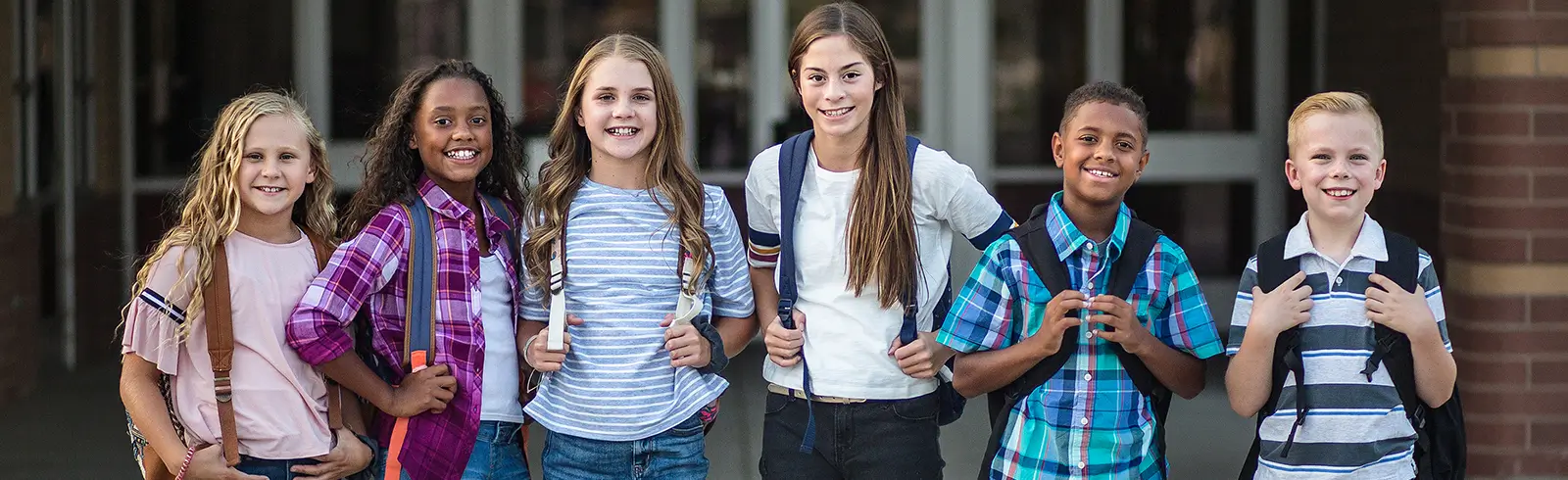
Multi-age groupings of children ages 6 – 9 and 9 – 12 (or 6 – 12) provide a heterogeneous mix in which children can collaborate and socialize. These inter-age relationships strengthen the entire community.
Older children are seen as role models within the community. They support the growth and development of younger children through socialization, assisting with new work, or teaching skills they have mastered themselves. They can also work with younger students in areas of the curriculum in which they themselves may need more practice, without stigma.
Younger children follow the example set by the older students, and have peers to work with in areas of the curriculum in which they may be more advanced. This multi-age community provides opportunities for all individuals to learn from each other, at times leading, sharing, or serving as role models. It also develops an appreciation of differences.
Within this supportive, inclusive community, children work through the curriculum at their own pace, accelerating during some tasks or taking additional time with others.
A Time of Curiosity and Imagination
In Lower Elementary, children enter a period of expansive curiosity. They begin to ask deeper questions about the world and are eager to understand how things work and why. This stage uses rich storytelling, hands-on exploration, and meaningful academic work to capture the student’s imagination while building strong foundational skills.
Concrete Learning to Build Understanding
Students are introduced to core academic concepts through materials that make learning visible and tangible. In mathematics, language, science, and cultural studies, children work with materials that allow them to see patterns, relationships, and structure before moving into more abstract thinking.
This approach builds a lifelong understanding—not just memorization.
“The study of grammar is to language what the study of anatomy is to science. By studying grammar, we become better writers and readers.”Lori Bourne Montessori for Everyone
Elementary Grades 1-3 Curricular
Language Arts
The study of language arts is fully integrated across all aspects of the learning environment. Speaking articulately, writing with clarity, and reading with fluency are important goals of the language curriculum. In reading, students continue to work on decoding and fluency, semantics and syntax, vocabulary, literature and research skills and participate in Literature Circles. Writing focuses on the writing process, composing words, paragraphs, and essays, the mechanics of handwriting, cursive writing, keyboarding, punctuation, and spelling. Grammar studies include learning the parts of speech, sentence analysis, and advanced verb conjugation. Language lessons provide the fundamental building blocks for all future learning.
Mathematics Curriculum
The Lower Elementary math curriculum deepens the student’s understanding of simple mathematical operations that were first introduced in the Primary classroom. The Lower Elementary program offers a continuum of Montessori materials designed to provide a solid foundation for learning, understanding, and mastering basic operations, as well as more abstract concepts such as algebra and geometry. Students develop a conceptual understanding of number facts and functions, the value of money, the meaning of time and spatial relationships, as well as computational and problem solving skills.
Although traditionally, the study of geometry is undertaken in later years as an abstract series of rules, theorems, and propositions, Dr. Montessori saw geometry as firmly rooted in reality and built a curriculum that uses concrete, sensorial experimentation, leading students to concepts through their own creative research.
Science Curriculum
The Montessori science curriculum is focused on the study of life, the laws of life, the laws and structure of the universe, and how humanity has struggled throughout history to put our understanding to practical use. It teaches the students the process and philosophy of science: systemic observation, how to ask questions, collect specimens, gather and analyze data, and conduct experiments. Much of the science studies take place outdoors. Classmates grow flowers and vegetables in small gardens. They raise class pets and learn to recognize and name local trees, flowers, birds and animals and to identify familiar plants by their leaves, bark, and seeds.
Physical geography begins in the elementary program with the study of the formation of the Earth, the emergence of the oceans and atmosphere, and the evolution of life. Students learn about the world’s rivers, lakes, deserts, mountain ranges, and natural resources.
Elementary pupils also learn a wide range of important basic concepts of physics and chemistry, such as the structure of atoms and molecules, the difference between elements and compounds, the chemical composition of familiar compounds, three states of matter, and chemical and physical change. Students also enjoy doing research about the elements and receive first exposure to Mendeleev’s Table of the Elements.
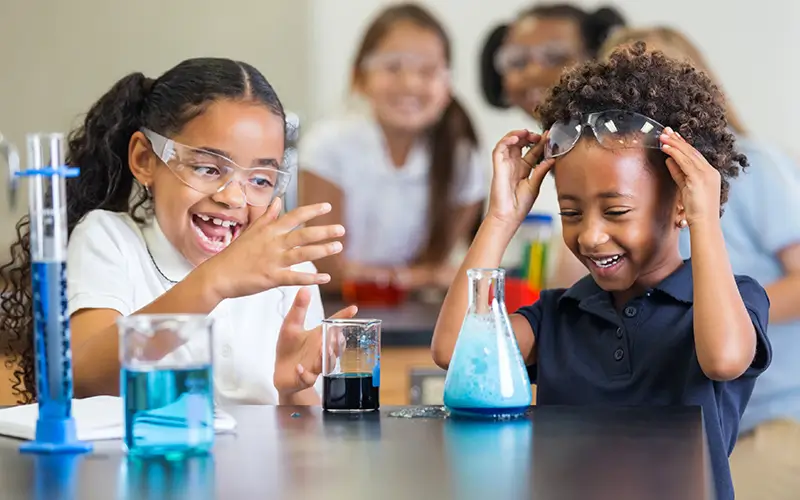
Elementary students love to work with scientific apparatus and delight in seeing mixtures change color or testing liquids with litmus paper. They learn to observe and record what takes place during their experimentations. We endeavor to teach both the scientific method and the techniques for safety while working with science equipment.
History & Cultural Studies
Dr. Montessori believed in the importance of global thinking and perspectives. The study of history and world cultures, therefore, is the cornerstone of the curriculum.
Elementary children study customs, housing, diet, government, industry, arts, history, and dress of countries around the world. They also study the emergence of early civilization, and American history.
The elementary program teaches history through hands-on experiences. Students build shelters, cook over a wood fire, hike, work with map and compass, and camp out. They build models of ancient structures, prepare their own manuscripts, and create everyday artifacts from the past.
Practical economics is another important element in the elementary Montessori curriculum. Pupils learn how to compare prices against value, compute costs, and maintain a checkbook. They study the work of the local, state and federal governments and begin to follow current events.
Elementary Arts Curriculum
The arts are integrated into all areas of the curriculum. They are models of exploring and expanding lessons which have been introduced in science, history, geography, language arts, and mathematics. For example, classmates might make a replica of a Grecian vase, study calligraphy, sculpt a dinosaur for science, create dioramas for history, or construct geometric designs and solids for math.
Art is an essential component of learning in Montessori classrooms. In each classroom there are dedicated art shelves ensuring students always have access to art materials for creative expression. We are focused on providing our students with the skills, materials, and exposure to art that they need in order to express their creativity at their own pace and level. From Toddlers to Adolescents, you will see students naturally turning to art in response to what they are learning and studying in other lessons. For example, a student in Children’s House learning about the parts of a plant may want to make a painting about it, while a Lower Elementary student studying France may spend weeks in Open Studio building an intricate model of the Palace of Versailles.
Art and music appreciation are woven throughout history and geography curricula.
Social Skills & Character
The Montessori classroom is a source of countless life-lessons in social skills, everyday courtesy, and ethics. The elementary classroom operates as a small social community in which children learn to work together, resolve conflicts, encourage each other, and work as committees to complete complex tasks.
Montessori children begin to seriously address the question of aid to the elderly and the economically disadvantaged. They explore international issues from the perspective of building world peace. They study ecology, wildlife preservation, and conservation of natural resources. The class recycles, plant wildflowers, and may raise funds for charity.
Through these and many other efforts, the Montessori students are introduced to moral questions in personal relationships and encouraged to awaken their first efforts at trying to understand war, violence, poverty, and the crisis of the homeless. More importantly, they discover what they can do as individuals to make the world a better place.
Developing Independence and Work Habits
Children begin to take increasing responsibility for their work. Within a carefully prepared environment, students learn to:
- choose meaningful work
- sustain attention
- complete tasks with care
- manage time and expectations
Teachers provide clear structure and guidance while allowing space for independence to grow.
Learning In Community
The Lower Elementary classroom is a collaborative environment where children learn alongside and from one another.
Students practice:
- working together
- sharing ideas
- resolving conflict respectfully
- supporting peers
This social learning is essential at this stage, as children develop both confidence and a sense of belonging.
First Steps Toward Research and Exploration
Students begin engaging in early research and project work, learning how to:
- ask questions
- gather information
- share their understanding
These experiences lay the groundwork for the more advanced, self-directed work of Upper Elementary.